Bayesian Conformal Prediction as a Decision Risk Problem
Sep 29, 2025· ,,,·
0 min read
,,,·
0 min read
Fanyi Kaitlyn Wu
Veronika Lohmanova
Samuel Kaski
Michele Caprio
 Comparison between Bayesian prediction and Bayesian Conformal Prediction (BCP) under different prior scales. (a) Coverage vs. average interval width. (b) Interval visualization for individual test samples. (c, d) Interval widths for a range of test cases with prior scale c=0.02 (misspecified) and c=1 (well-specified).
Abstract
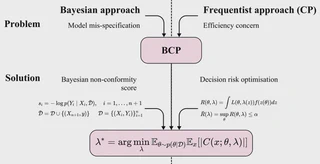
We propose an optimised Bayesian Conformal Prediction (BCP) framework that selects the conformal threshold via a decision-theoretic risk minimisation criterion. BCP uses Bayesian posterior predictive densities as non-conformity scores and Bayesian quadrature to estimate and minimise the expected prediction set size. Operating within a split conformal framework, BCP provides valid coverage guarantees and demonstrates reliable empirical coverage under model misspecification. Across regression and classification tasks, including distribution-shifted settings such as ImageNet-A, BCP yields prediction sets of comparable size to split conformal prediction, while exhibiting substantially lower run-to-run variability in set size. In sparse regression with nominal coverage of 80 percent, BCP achieves 81 percent empirical coverage under a misspecified prior, whereas Bayesian credible intervals under-cover at 49 percent.
Type
Publication
NeurIPS EIML Workshop 2025
