Space-time optical diffraction from synthetic motion
Jun 3, 2025·
,,, ,,,,·
0 min read
,,,,·
0 min read
Harwood, A. C.
These authors contributed equally: A. C. Harwood, S. Vezzoli
,Vezzoli, S.
Raziman, T. V.
Hooper, C.
Tirole, R.
Fanyi Kaitlyn Wu
Maier, S. A.
Pendry, J. B.
Horsley, S. A. R.
Sapienza, R.
 Overview of THCM-CAL. A four-stage pipeline for clinical risk prediction, which consists of: (1) Extracting diagnostic propositions and normalize ICD descriptions, (2) Embeding nodes with BERT, (3) Building and fuse a temporal–hierarchical causal graph via Gumbel–Softmax and message passing, and (4) Appling split conformal prediction for calibrated multi-label ICD coding.
Abstract
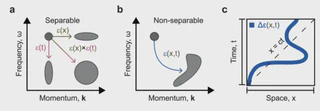
The interaction of light with objects and media moving at relativistic and superluminal speeds enables unconventional phenomena such as Fresnel drag, Hawking radiation, and light amplification. Synthetic motion, facilitated by modulated internal degrees of freedom, enables the study of relativistic phenomena unrestricted by the speed of light. In this study, we investigate synthetically moving apertures created by high-contrast reflectivity modulations, which are generated by ultrafast laser pulses on a subwavelength thin film of indium tin oxide. The space-time diffraction of a weaker probe beam reveals a complex, non-separable spatio-temporal transformation, where changes in the frequency of the wave are correlated to changes in its momentum. By using schemes of continuous or discrete modulation we demonstrate tunable frequency-momentum diffraction patterns with gradients that depend upon the relative velocity between the modulation and the probe wave.
Type
Publication
Nature Communications
