Decoupled Conformal Optimisation: Efficient Prediction Sets via Independent Tuning and Calibration

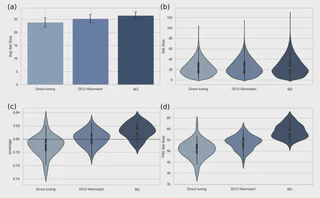 Classification results on ImageNet-A over 50 random splits. (a) Mean prediction set size. (b) Set size distributions. (c) Empirical coverage; dashed line marks 1 − α = 0.8. (d) P95 set size distributions.
Abstract
Bayesian conformal optimisation methods often use the same held-out data both to search for efficient prediction sets and to certify coverage or risk. This coupling is natural for high-probability risk-control guarantees, but it is not necessary when the target is standard finite-sample marginal conformal coverage. We propose Decoupled Conformal Optimisation (DCO), a train-tune-calibrate design principle that uses an independent tuning split for efficiency-oriented structural selection and a fresh calibration split for the final conformal quantile. Conditional on the tuned structure, standard split-conformal exchangeability yields finite-sample marginal coverage for any candidate class, without a confidence parameter or multiple-testing correction. DCO therefore targets a different finite-sample guarantee from PAC-style methods: marginal conformal coverage rather than high-probability risk control. Under consistency assumptions on the coupled risk bound, the two approaches nevertheless converge to the same population threshold. Across classification and regression benchmarks, including ImageNet-A, CIFAR-100, Diabetes, California Housing, and Concrete, DCO tracks the nominal coverage level closely while often reducing average prediction-set size or interval width relative to PAC-style calibration. On ImageNet-A, for example, the average set size decreases from 26.52 to 25.26 and the 95th-percentile set size from 58.95 to 53.73; on Diabetes, the average interval width decreases from 2.098 to 1.914.
Type
Publication
ICML EIML Workshop 2026
