THCM-CAL Temporal-Hierarchical Causal Modelling with Conformal Calibration for Clinical Risk Prediction
Jun 21, 2025·
 ,·
0 min read
,·
0 min read
Xin Zhang
Equal contribution
,Qiyu Wei
Equal contribution
,Yingjie Zhu
Fanyi Kaitlyn Wu
Sophia Ananiadou
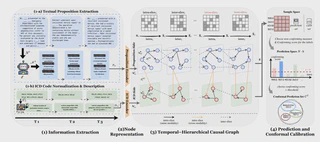 Overview of THCM-CAL. A four-stage pipeline for clinical risk prediction, which consists of: (1) Extracting diagnostic propositions and normalize ICD descriptions, (2) Embeding nodes with BERT, (3) Building and fuse a temporal–hierarchical causal graph via Gumbel–Softmax and message passing, and (4) Appling split conformal prediction for calibrated multi-label ICD coding.
Abstract
Automated clinical risk prediction from electronic health records (EHRs) demands modeling both structured diagnostic codes and unstructured narrative notes. However, most prior approaches either handle these modalities separately or rely on simplistic fusion strategies that ignore the directional, hierarchical causal interactions by which narrative observations precipitate diagnoses and propagate risk across admissions. In this paper, we propose THCM-CAL, a Temporal-Hierarchical Causal Model with Conformal Calibration. Our framework constructs a multimodal causal graph where nodes represent clinical entities from two modalities: Textual propositions extracted from notes and ICD codes mapped to textual descriptions. Through hierarchical causal discovery, THCM-CAL infers three clinically grounded interactions: intra-slice same-modality sequencing, intra-slice cross-modality triggers, and inter-slice risk propagation. To enhance prediction reliability, we extend conformal prediction to multi-label ICD coding, calibrating per-code confidence intervals under complex co-occurrences. Experimental results on MIMIC-III and MIMIC-IV demonstrate the superiority of THCM-CAL.
Type
Publication
EMNLP 2025
